The international community’s intention is to appreciably advance global protection of the environment, climate and natural resources via the SDGs. These topics are also of key importance for DEG and its customers.
To achieve its climate target of reducing greenhouse gas emissions in line with the Paris Agreement’s 1.5 ℃ goal in order to make DEG’s portfolio net-zero in 2040, DEG will make no new high-emissions investments without agreeing on a transformation pathway that is compatible with the Paris objective. DEG will invest even more in climate-friendly business models, provide targeted advice to its customers on their transformation and climate change adaptation pathways, and step up investment in forestry and carbon sink projects certified to internationally recognised standards.

In the carbon reporting of financial institutions promoted by DEG, Scope 3–15 emissions are particularly relevant. These comprise the emissions of companies financed by these institutions and represent indirect greenhouse gas emissions arising from the activities of the companies financed. Modelling using the Joint Impact Model (JIM) shows a total footprint of 173 million t CO2e per annum for financial institutions promoted by DEG.
DEG’s direct customers in manufacturing and infrastructure have a total footprint of 34 million t CO2e per annum (Scope 1 and 2 emissions).
Through their lending and investment decisions, banks are able to target financing towards investments that promote environmentally friendly technologies and sustainable practices. By offering green bonds or sustainable funds, for example, they can positively influence their customers’ climate targets and increase awareness of environmental responsibility.
Industrial companies, meanwhile, often have a more direct influence on climate impacts, as their production processes and supply chains can produce significant greenhouse gas emissions. These businesses therefore have a responsibility to optimise their production methods in order to reduce energy consumption and increase the use of renewable energy.
For industrial companies in particular, climate impact is closely linked to the commercial success of their business activities. Measures aimed at a positive climate impact are not just a reaction to increasing regulatory requirements and societal expectations, but also bring long-term commercial benefits such as efficiency gains and the mitigation of climate risks. Responsibility for climate action is therefore integral to companies’ strategic direction. There is good climate governance at
47% of companies and infrastructure customers, and
34% of funds.
Entrepreneurial commitment and innovative solutions for global environmental protection, climate action and resource efficiency are critical to sustainable and long-term economic development. Large parts of the global private sector rely on natural and limited resources either as part of their core business or in their supply chains. More than ever, it requires them to be managed as sustainably and efficiently as possible.
All manufacturing companies and protagonists in infrastructure projects in DEG’s portfolio commit to complying with or introducing international environmental and social standards. During due diligence, the current status is recorded and, where necessary, an action plan is drawn up. DEG expects banks and funds to implement their own environmental and social risk management systems and to appropriately manage potential environmental and social risks for their customers. This enables risks to be mitigated and investment opportunities to be identified, and also enhances their reputations. By promoting compliance with international environmental and social standards and initiatives for more sustainable business activities, DEG is contributing to SDG 12 (Responsible production).
78% of DEG direct customers already comply with international environmental standards.
DEG’s customers can impact regional biodiversity through their business activities. For the first time, the DERa now records whether critical or natural habitats are affected or in the vicinity and whether the impact is well managed. It also recognises positive impacts of DEG customers on biodiversity, including through co-benefits programmes and nature-based solutions.
DEG also advises its customers across industries and regions on developing and implementing environmental and social risk management systems, on collecting emissions data and identifying reduction potential, and on developing their own climate action strategies. It also helps them to obtain certification in line with international standards. Around 50% of the BSS measures at DEG Impulse, which specialises in advising on sustainable transformation, contribute to these areas.
More information on the
Business Support Services (BSS)25.2 TWh of electricity from renewable energies: technologies applied
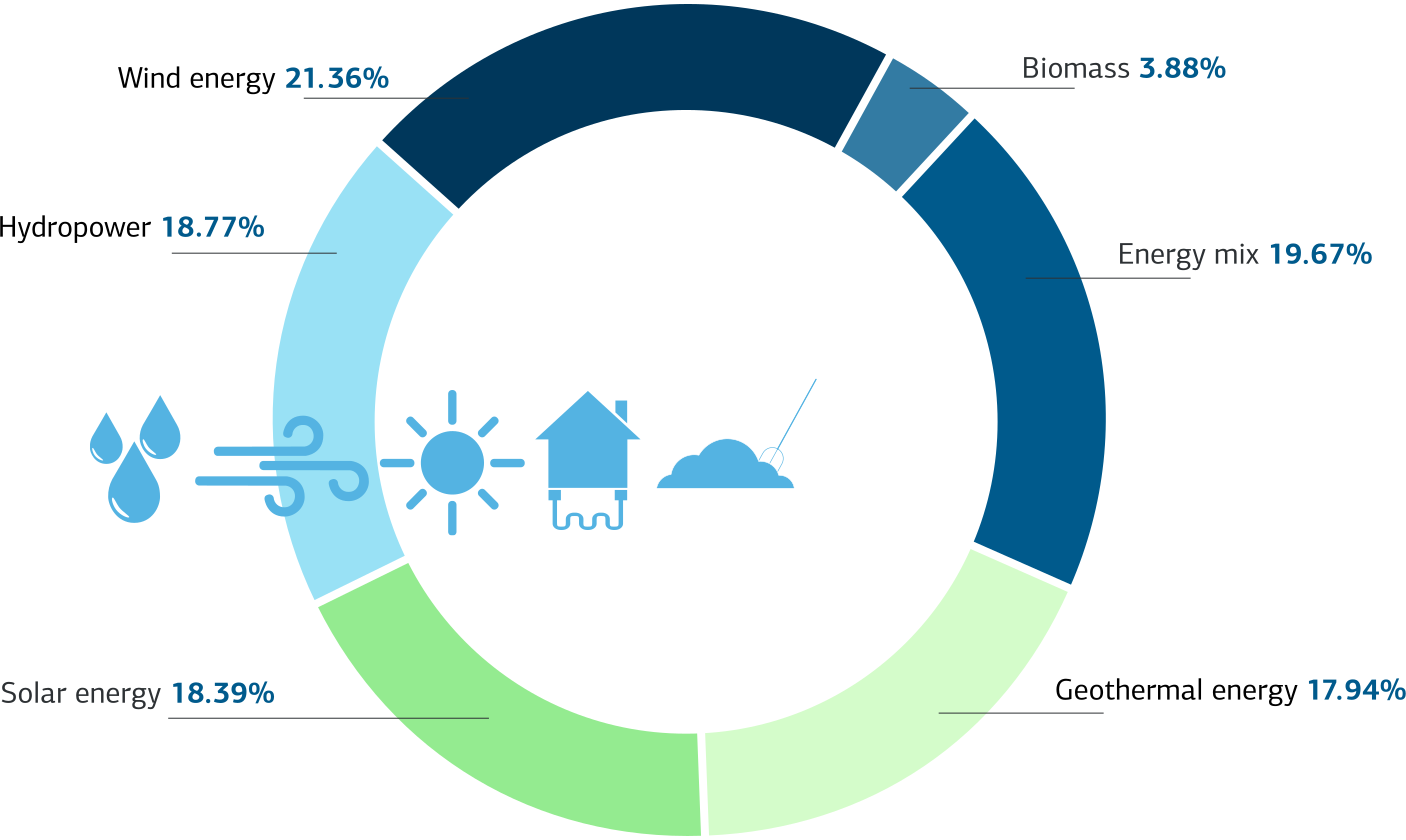
The energy utilities and power stations that are financed directly by DEG make their own contribution to SDG 7 (Affordable and clean energy) and SDG 13 (Climate action). They produce around 25.2 TWh of electricity from renewable energy sources each year, currently supplying over 46 million people. This reduces emissions of carbon dioxide (CO2), the main greenhouse gas, by more than 13 million tonnes CO2 per year. Solar, wind, hydroelectric and geothermal energy account for around 59% of electricity from renewable sources.
In addition, companies that DEG invests in indirectly via funds produce 8.9 TWh of renewable energy with a focus on biomass and reduce emissions by a further 6 million tonnes of CO2 per year.
Environmentally friendly expansion investments for paper production at Klingele family business
Name: Klingele
Invested volume (in EUR): 40 million
Country: Brazil
DERa category: Environmental stewardship
Environmentally friendly technologies and use of renewable energies are key to making paper manufacturing energy-efficient. DEG provides a long-term loan totalling EUR 40 million to the Brazilian subsidiary of the Klingele Group to fund expansion. The investment is intended to make local production of corrugated base paper even more efficient and environmentally friendly. The total amount invested comes to over EUR 100 million.
Headquartered in Remshalden, near Stuttgart, Germany, the Klingele Group is one of the country’s leading corrugated cardboard producers. With a workforce of around 3,200 across 24 locations in Europe, Africa and Latin America, Klingele manufactures paper and packaging solutions made from corrugated cardboard. To do so, the company uses sustainable products such as corrugated board sheets made from recycled paper or sustainable virgin fibre paper. In 2021, Klingele acquired a paper mill in the Nova Campina region in the federal state of São Paulo that had been in existence since as far back as 1930. Klingele Paper Nova Campina Ltda. (Klingele Brazil) primarily manufactures a particularly robust grade of paper that is used for the production of corrugated cardboard.
The company will use the funds to further reduce the consumption of water and energy in its Brazilian production facility. Thanks to the existing hydropower plant and the installation of a new biomass boiler, the company will be able to meet the bulk of its energy needs from its own renewable sources. Overall, CO2 emissions are expected to be cut by up to 75%. Klingele Brazil uses only FSC-certified and FSC-controlled wood in its production.
Photovoltaic plants with battery storage secure decentralised energy supply
Name: Axian Energy
Invested volume (in EUR): 23 million
Country: Senegal
DERa category: Environmental stewardship
The infrastructure in the rural region of Casamance, in the south of Senegal, is greatly lacking. Many households are not connected to the power grid and the supply of electricity – which, for the most part, has been produced using imported fossil fuels to date – remains unstable.
DEG is now investing in two photovoltaic systems with battery storage operated by Axian Energy. This is in order to help the region develop and to improve its electricity supply and also to increase the use of renewable energies there. The overall investment volume is around EUR 100 million, of which EUR 23 million will be provided by DEG. Other investors are Dutch development finance institution FMO and the Emerging Africa and Asia Infrastructure Fund (EAAIF).
Scheduled for completion in 2026, the photovoltaic systems in the southern Senegalese region of Kolda will have an annual capacity of 60 MW. This means that they will be able to provide an estimated 235,000 people with green electricity. The 72 MWh battery storage will help to safeguard the supply of power for up to three hours during evening peak times and increase the stability of the power grid. In this way, renewable energies will be integrated into the power supply, helping Senegal to produce at least 40% of its electricity from renewable energy sources by 2030.


