Sustainable business practices in line with the SDGs are central to DEG’s work. With its commitment and its international network, DEG cooperates with its customers to enable and accelerate transformation in order to boost business resilience and sustainable economic development and to improve the living standards of people in developing countries for the long term.
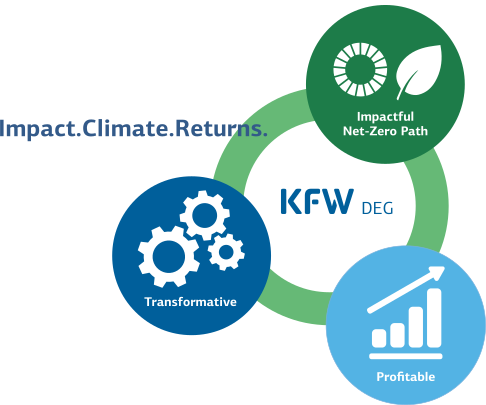
As part of its focused impact and climate strategy, which it began to implement in 2022, DEG has identified three key fields of action, which are outlined in its DEG Impact/Climate Commitments.
DEG will
further enhance the positive development impact of its customers on society and the environment;
reduce greenhouse gas emissions in line with the Paris Agreement’s 1.5 ℃ goal and neutralise the remaining portfolio GHG emissions by 2040;
actively support customers with their transformation in order to strengthen their resilience and achieve even greater development impact.
DEG regularly records and reviews progress on these tasks.
Progress on these activities is reported below.

Impact Commitment
DEG is committed to increasing its customers’ contribution to the economic, social and environmental objectives as indicated by the Sustainable Development Goals (SDGs), thereby continuously improving the positive development impact of its investments.
Status
DEG has been recording development impact using its internationally recognised Development Effectiveness Rating (DERa) since 2017.
As part of DEG’s focused strategy, the DERa was updated to become DERa 2.0 in 2023, with technical implementation following in 2024. DERa 2.0 incorporates additional aspects into the five existing impact dimensions. It also records the net impact of DEG customers and integrates DEG’s transformative role into the rating. The impact measurement will be used in portfolio company management in future. This Development Report presents the DERa 2.0 results for the first time.
DEG is also continuously refining its services and programmes for impact topics such as gender equality, education and training, and climate strategies (see also Commitment to transformation).
Operating Principles for Impact Management
DEG was one of the first signatories of the Operating Principles for Impact Management, which sets standards for business strategy, business development, structuring, management and assessment of development effectiveness for private investments. Under these standards, DEG’s impact management is verified and affirmed by an independent external institution.
Principle 6 concerns the monitoring of each investment’s progress. The Development Effectiveness Rating (DERa) enables the development impact of each customer to be measured at the start of the investment and each year thereafter in the portfolio. This means that DEG maintains an overview of each individual customer’s contribution to the SDGs at all times and can work with them on improvements in a targeted manner. It also allows overarching developments to be tracked at the same time.

Climate Commitment
In line with the 1.5 ℃ target of the Paris Agreement, DEG is committed to reducing the GHG emissions financed by DEG. Its climate strategy is based on the following hierarchy of targets:
- avoiding greenhouse gas (GHG) emissions
- working with its customers to implement climate-related transformation pathways to reduce GHG emissions and increase their climate resilience
- neutralising the remaining GHG emissions financed by DEG through direct investment in sink projects
Since 2022, DEG has been on a science-based transformation pathway with the aim of reducing the GHG intensity of its investments at portfolio level by an annual average of 4.2%, thereby cutting the portfolio-level GHG intensity of its operating activities by two-thirds by 2040.
DEG is neutralising the remaining GHG emissions attributed to its portfolio by investing in forestry and other carbon sink projects that are certified by internationally recognised standards and permanently remove the remaining attributed GHG emissions from the atmosphere.
Status
DEG pressed ahead in the reporting period with the implementation and development of its climate strategy. Recording the GHG emissions financed by DEG and the GHG intensity of DEG’s operating activities was an important instrument in this context. The majority of portfolio emissions for customers from the Infrastructure and Energy and Industries and Services clusters were calculated using reported emission figures and/or the physical energy consumption of the customer. Based on this, GHG budget approaches are being incorporated into portfolio company management for the first time in 2025.
For customers from the Financial Institutions cluster, emissions are modelled with the aid of the Joint Impact Model (JIM). A special climate marker has also been developed to enable qualitative portfolio management.
DEG’s total share in its customers’ GHG emissions declined to 2.2 million t CO2e for 2023 (2022: 2.3 million t CO2e). This change is also reflected in the emissions intensity of the DEG portfolio, which decreased in 2023 to 266 t CO2e per million euros invested (2022: 289 t CO2e per million euros invested).
To actively shape their climate pathways, DEG supports its customers through numerous projects that advise them on building systems to collect emissions data, identify potential reductions and develop their own climate action strategies to achieve zero emissions.
DEG has been investing in long-term forestry and climate action projects since 2022 to neutralise its remaining portfolio emissions.

Commitment to transformation
DEG is committed to working with its customers to ensure a tailored approach to sustainable transformation and climate-sensitive business in line with the SDGs – in its management and internal operations, along its supply chains and in regional contexts. This will enable DEG to achieve its impact and climate targets collaboratively with its customers.
Status
DEG defines positive transformation as improvements in its customers’ environmental, social and economic performance. Transformative aspects are often central to the purpose of the financing. Examples include credit lines for environmental and climate action, supporting women in the labour market or financing resource efficiency measures.
DEG’s transformative collaboration with its customers boosts business resilience and sustainable economic development and makes a substantial contribution to the Sustainable Development Goals.
The advisory services offered by DEG’s subsidiary DEG Impulse are key to the success of this transformation. DEG Impulse provides funding and advice predominantly through its develoPPP and Business Support Services (BSS) programmes, which are closely integrated with DEG’s activities and strategic transformation goals. No fewer than 56% of the BSS measures in 2024 supported the climate-related transformation efforts of DEG customers, and over 40% improved their environmental and social performance.
To support its customers in their transformation, DEG has expanded its network of impact and climate expertise over recent years. Among other measures, it has created a Senior Impact & Climate Manager job profile in the customer clusters and employed climate experts at DEG Impulse. Climate was the focus of transformation in 2024. In the Financial Institutions customer cluster, for example, a “climate marker” has been established. This evaluates and helps to further refine the climate strategies of partner institutions. In the Industries & Services customer cluster, DEG has increased the support offered to high emitters for their transformation efforts along with the climate advice it provides to funds. In the Infrastructure and Energy customer cluster, it has expanded its toolbox of advice for companies.